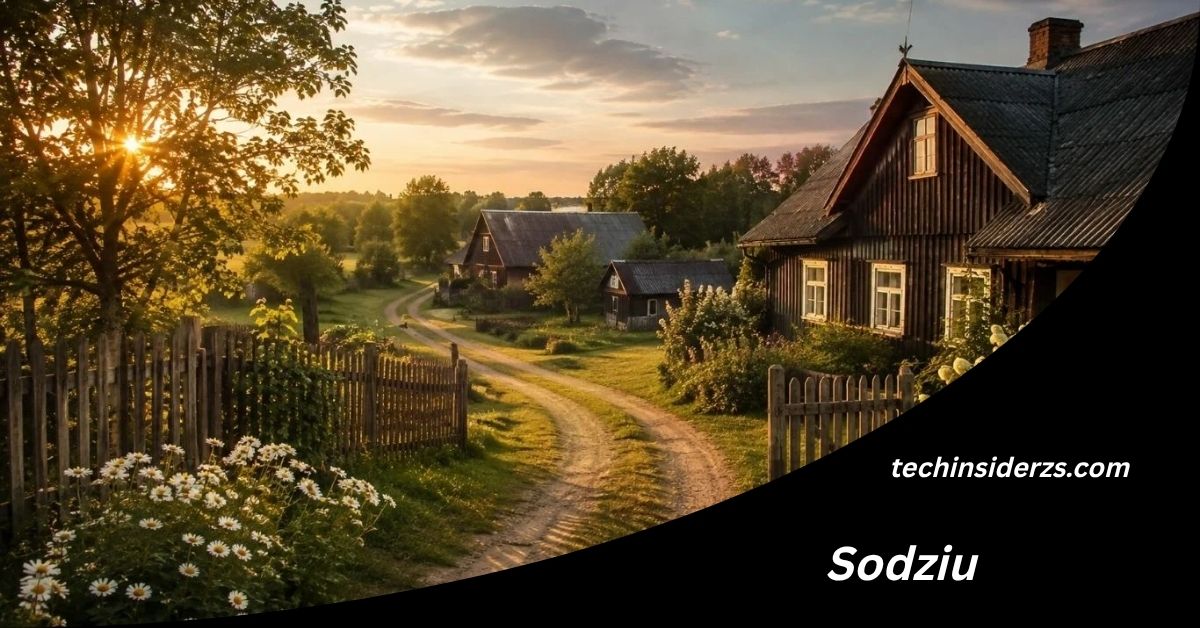
Sodziu: Meaning, Lithuanian Origins, Cultural Heritage, and Why the Word Matters
The word “sodziu” may look simple, but it can lead to a deeper exploration of Lithuanian language, rural life, history, and cultural identity. In Lithuanian, the standard spelling is generally connected with the word “sodžius,” which refers to a village or rural settlement. Without Lithuanian diacritical marks, the form “sodziu” may appear in searches, databases, usernames, transcriptions, or informal writing.
Understanding sodziu therefore requires more than translating one word. The term can open a window into how Lithuanian communities historically organized rural life, how language describes places, and how traditional village culture continues to influence modern ideas about heritage and belonging.
This guide explains what sodziu means, where the term comes from, how it relates to the Lithuanian word sodžius, and why rural settlements have an important place in Lithuanian culture.
What Does Sodziu Mean?
Sodziu is best understood as a simplified, non-diacritic spelling associated with the Lithuanian word “sodžius,” meaning a village or rural settlement.
In Lithuanian, diacritical marks are an important part of standard spelling. When those marks are removed for technical, typing, search, or international-use reasons, Lithuanian words can appear in simplified forms. This helps explain why someone searching for “sodziu” may actually be looking for information about “sodžius.”

In a cultural context, the word is associated with ideas such as:
- Village life
- Rural communities
- Traditional settlements
- Agriculture
- Family and neighbors
- Lithuanian countryside
- Cultural heritage
- Local identity
- Shared traditions
- Connection to land
The exact meaning can depend on context. A person may encounter sodziu while researching Lithuanian history, translating a Lithuanian text, studying genealogy, exploring place names, or searching for information about rural traditions.
Sodziu and the Lithuanian Word Sodžius
The most important linguistic connection is between sodziu and sodžius.
The Lithuanian language uses special characters that are not always reproduced when words are typed on systems that do not support Lithuanian spelling. The letter “ž,” for example, can be represented without its diacritic in simplified text.
As a result, a Lithuanian word containing diacritical marks may appear in an ASCII-style form online.
The relationship can therefore be understood simply:
“Sodziu” → simplified spelling
“Sodžius” → Lithuanian spelling associated with a village or rural settlement
There is also an important grammatical point. Lithuanian words change form depending on their role in a sentence. Therefore, someone encountering “sodžiu” in an actual Lithuanian sentence should not automatically assume that it is simply another spelling of the dictionary form “sodžius.”
Lithuanian grammar is highly inflected, meaning endings can change according to case, number, and grammatical function.
This distinction matters when translating historical documents or interpreting Lithuanian text.
Why the Spelling “Sodziu” Appears Online
There are several reasons why a word such as sodziu may appear without Lithuanian characters.
Keyboard Limitations
Older computer systems and keyboards did not always make Lithuanian characters easy to type. People sometimes replaced accented or marked letters with ordinary Latin letters.
This practice can still appear in informal communication.
Search Engine Behavior
People may search without knowing the correct Lithuanian spelling. Search engines can sometimes connect simplified spellings with words containing diacritical marks.
For someone outside Lithuania, typing “sodziu” may be easier than determining exactly where the Lithuanian marks belong.
Digital Databases
Historical databases, genealogical records, catalog systems, and older software may have restrictions on character sets. Some records were created using simplified Latin characters.
International Communication
When Lithuanian words are shared with people who do not use Lithuanian keyboards, simplified spellings can make communication easier.
Usernames and Website Addresses
Internet addresses and usernames often avoid special characters. A Lithuanian word containing “ž” may therefore appear online in a simplified form.
These technical factors do not necessarily indicate that “sodziu” is a separate Lithuanian word. Context is important.
What Is a Lithuanian Village?
To understand sodziu, it helps to understand the traditional idea of a Lithuanian village.
A village is more than a collection of houses. Historically, rural settlements were social and economic communities. People lived close to agricultural land, worked with animals and crops, exchanged goods and services, and developed shared customs.
In traditional Lithuanian society, the countryside played a major role in everyday life.
Families often depended on:
- Farming
- Livestock
- Gardening
- Forestry
- Fishing in suitable regions
- Food preservation
- Household crafts
- Local trade
The village could therefore function as a practical network as well as a social community.
People knew their neighbors, shared responsibilities, and participated in seasonal activities together.
This broader meaning helps explain why a word connected with a village can carry cultural associations beyond geography.
Sodziu and Lithuanian Rural Heritage
Lithuania has a strong rural heritage. For centuries, much of the population lived outside major towns and cities.
The countryside shaped:
- Food traditions
- Architecture
- Clothing
- Music
- Folklore
- Agricultural practices
- Religious customs
- Seasonal celebrations
- Family traditions
- Local dialects
When people discuss sodziu from a cultural perspective, they may therefore be thinking about an entire way of life rather than simply a physical settlement.
A village could represent a connection between people and the land.
That connection remains important when studying Lithuanian cultural history today.
The Historical Importance of Lithuanian Villages
Lithuanian rural settlements changed considerably over time.
Their development was influenced by agriculture, land ownership, political changes, population movements, transportation, modernization, and changes in economic life.
Medieval and early modern rural communities did not look exactly like modern villages. Settlement patterns varied across regions and periods.
Over time, farming systems and land organization changed.
One significant development in Lithuanian agricultural history was the reorganization of land into more systematic field arrangements. These changes influenced how farms and villages were structured.
This means that the historical meaning of a Lithuanian village should not be treated as something fixed.
Instead, rural settlement patterns evolved with society.
Sodziu and the Lithuanian Countryside
The Lithuanian countryside is often associated with forests, agricultural fields, rivers, lakes, meadows, and traditional wooden buildings.
However, it is important not to reduce Lithuanian rural culture to a romantic picture of nature.
Rural life was also demanding.
Farm families had to deal with:
- Long working days
- Weather conditions
- Crop failures
- Food storage
- Animal care
- Seasonal labor
- Economic uncertainty
- Difficult transportation
- Changing political conditions
Understanding both sides gives a more accurate picture.
The village represented community and tradition, but it was also a place where people worked hard to maintain their households.
Traditional Village Architecture in Lithuania
Architecture provides another way to understand the world associated with sodžius.
Traditional Lithuanian rural architecture often included wooden houses, barns, storage buildings, animal shelters, wells, fences, and other structures needed for farm life.
Building styles differed by region.
Some rural houses were simple and practical, while others reflected local craftsmanship and family circumstances.
Wood was an important building material because it was widely available in Lithuania.
Traditional structures can reveal information about:
- Local resources
- Family size
- Economic status
- Climate
- Agricultural practices
- Craft traditions
- Regional identity
Historic rural architecture is therefore an important part of Lithuanian heritage.
Sodziu and Community Life
One of the strongest cultural ideas connected with a traditional village is community.
Village residents often depended on each other.
A neighbor might help with agricultural work, construction, transportation, food preparation, or an important family event.
Community relationships were especially valuable before modern transportation and communication made it easy to contact people outside one’s immediate area.
This created a strong sense of local identity.
People could identify themselves not only by family name or occupation but also by their village and region.
For genealogy researchers, these village connections can be extremely valuable.
Sodziu and Family History
People researching Lithuanian ancestry may encounter village-related terms in historical records.
A family’s history might be connected to a particular:
- Village
- Parish
- District
- Farmstead
- Town
- Region
This information can help researchers understand where ancestors lived and how families moved over generations.
Also Read: TechTrendery.com USA: A Complete Guide to the Technology Website
Historical documents may contain Lithuanian place names in different spellings because of changes in language, administration, transcription, and record-keeping practices.
For this reason, someone searching for “sodziu” should be prepared to encounter several spelling forms.
When researching genealogy, it is useful to compare:
- Original-language records
- Modern Lithuanian spellings
- Older historical spellings
- Simplified spellings
- Local place-name variations
This approach can prevent a small spelling difference from hiding an important historical connection.
How Lithuanian Diacritics Affect Search Results
Lithuanian uses several letters with diacritical marks, including:
- ą
- č
- ę
- ė
- į
- š
- ų
- ū
- ž
These characters can matter in written Lithuanian.
Removing the marks can make a word easier to type but may also create ambiguity.
For international readers, “sodziu” is easier to enter on an English keyboard. A Lithuanian speaker, however, may recognize that the simplified form does not necessarily provide enough information to determine the exact grammatical form.
This is an important lesson in digital language research: a search spelling is not always the same thing as a standardized dictionary spelling.
Is Sodziu a Lithuanian Word?
The safest way to understand sodziu is as a form connected with Lithuanian vocabulary involving “sodžius,” rather than automatically treating “sodziu” as an independent modern dictionary entry.
The absence of diacritical marks can change how a word looks without necessarily changing the underlying linguistic connection.
At the same time, Lithuanian inflection means that word endings matter.
Therefore, anyone translating sodziu should examine the original sentence.
A single isolated word may not provide enough information to determine its precise grammatical meaning.
What Does Sodžius Represent Culturally?
Beyond its literal village meaning, sodžius can evoke a broader cultural image.
It may represent:
- Ancestral roots
- Rural identity
- Community
- Tradition
- Shared labor
- Family memory
- Connection with nature
- Local customs
- Generational knowledge
This is why the idea behind sodziu can be meaningful even when someone is studying the term from outside Lithuania.
Words connected with places often become symbols of identity.
A village can be both a geographic location and a memory of people, traditions, and relationships.
Sodziu and Lithuanian Traditions
Traditional Lithuanian rural communities developed customs around the agricultural calendar.
The year was organized around seasonal changes.
Spring brought preparation and planting. Summer involved intensive agricultural work. Autumn focused on harvesting and preparing food for winter. Winter provided a slower period for certain household activities, crafts, storytelling, and community gatherings.
Seasonal traditions could include:
- Songs
- Food preparation
- Family gatherings
- Religious observances
- Folk customs
- Agricultural celebrations
- Storytelling
- Handcrafts
These traditions were often passed from one generation to another.
The village was an important setting where this knowledge could survive.
The Role of Folk Culture in Rural Lithuania
Lithuanian folk culture includes a rich tradition of songs, stories, crafts, dances, and seasonal customs.
Folk songs, often called dainos, are especially important to Lithuanian cultural heritage.
Rural communities played a major role in preserving such traditions.
This does not mean every village had exactly the same customs. Regional differences were significant.
Different parts of Lithuania developed distinctive traditions influenced by geography, history, language, and contact with neighboring communities.
The concept of sodziu can therefore be connected to both shared Lithuanian culture and local diversity.
Sodziu and Lithuanian Identity
Language can carry cultural memory.
A simple word for a village can bring attention to the importance of place in personal and national identity.
For many families, rural origins remain part of their family story even when later generations move to cities or other countries.
Lithuanian migration also means that people with Lithuanian heritage can now live throughout the United States and other parts of the world.
A word such as sodziu may therefore appear in genealogy projects, cultural discussions, family histories, and heritage research.
Lithuanian Villages and Modernization
Modernization changed rural Lithuania significantly.
Mechanized agriculture reduced the need for some forms of manual labor. Roads and transportation improved. Education and employment opportunities encouraged some people to move toward towns and cities.
At the same time, rural communities continued to evolve rather than simply disappear.
Some villages became smaller. Others remained active residential communities. Some historic settlements gained importance as cultural or tourism destinations.
This demonstrates an important point: rural heritage is not necessarily frozen in the past.
It can change while still maintaining connections to earlier generations.
Sodziu in the Digital Age
Today, people may discover the term sodziu through internet searches rather than traditional books.
Digital technology has changed how language and heritage are studied.
Online searches can connect users with:
- Historical records
- Digital archives
- Genealogy databases
- Lithuanian language resources
- Academic research
- Museum collections
- Cultural organizations
- Maps
- Digitized books
However, online information should be evaluated carefully.
A webpage using “sodziu” may not necessarily be written by a Lithuanian language expert. A social media post may use an informal spelling. An automated translation may miss grammatical details.
For trustworthy research, compare multiple sources and give greater weight to established linguistic, academic, archival, and cultural institutions.
Common Search Intent Behind Sodziu
People searching for sodziu may have different goals.
Some may want a definition.
Others may be searching because they saw the word in:
- A Lithuanian document
- A family record
- A historical book
- A surname or place-name discussion
- A website
- A social media profile
- A genealogy database
- A translated text
There can also be a simple spelling question: “What does sodziu mean?”
Understanding search intent helps explain why the term can produce different types of results.
A dictionary-style search may focus on language, while a genealogy search may focus on rural settlements and historical locations.
Is Sodziu Related to a Specific Place?
Not necessarily.
“Sodziu” should not automatically be interpreted as the name of one particular Lithuanian village.
It is better to determine the context first.
If the term appears inside a sentence, the surrounding words may reveal its grammatical role. If it appears in a historical record, the document’s location and date may provide additional clues.
If it appears as a username or website name, it may have been selected because of its cultural associations rather than because it identifies a particular settlement.
Context is therefore essential.
Sodziu vs. Modern Lithuanian Village Life
It is useful to distinguish historical village life from life in Lithuania today.
Modern rural communities have access to technologies and services that earlier generations did not have.
Modern residents may use:
- Smartphones
- Internet services
- Modern farm machinery
- Cars
- Online banking
- Digital government services
- Modern healthcare
- Contemporary education systems
At the same time, some rural communities continue to preserve traditional buildings, local celebrations, crafts, foods, and family customs.
This mixture of old and new is one of the most interesting aspects of contemporary rural heritage.
Why Rural Heritage Still Matters
Rural heritage matters because it helps explain how societies developed.
Agriculture influenced settlement patterns. Settlement patterns influenced family relationships. Family relationships helped transmit language and traditions.
Studying villages can therefore reveal connections between:
- Geography
- Economics
- Language
- Family
- Culture
- Architecture
- Food
- Religion
- Social organization
The word sodziu provides a small entry point into this larger subject.
It shows how a simple geographic term can be connected to a much broader cultural story.
How to Research Sodziu Correctly
If you are researching the word for an academic, family-history, or translation project, follow a few basic steps.
Start With the Original Context
Find the sentence or paragraph where the word appears.
The surrounding text may clarify its meaning.
Check Lithuanian Spelling
Compare the simplified spelling with Lithuanian forms that use diacritics.
Consider Grammar
Do not assume that every occurrence of sodziu has exactly the same grammatical function.
Check the Date
Historical Lithuanian records can use older spellings or administrative conventions.
Compare Reliable Sources
Use dictionaries, linguistic references, archives, museums, and academic resources where possible.
Avoid Automatic Translation as the Final Answer
Machine translation can be useful as a starting point, but unusual or historical forms require additional checking.
This method is especially useful for genealogy and historical documents.
Common Misunderstandings About Sodziu
Several mistakes can occur when people encounter this term online.
Mistake 1: Assuming It Is English
Sodziu is associated with Lithuanian language and should not automatically be interpreted through English vocabulary.
Mistake 2: Treating It as One Exact Place
The term’s village-related meaning does not mean it identifies a specific village.
Mistake 3: Ignoring Lithuanian Grammar
Lithuanian uses grammatical cases, so an inflected form may not have exactly the same role as a dictionary headword.
Mistake 4: Assuming Simplified Spelling Is Official Spelling
Removing diacritics may be useful for searching, but it does not necessarily represent standard Lithuanian orthography.
Mistake 5: Romanticizing Rural Life
Lithuanian villages are important cultural subjects, but historical rural life included significant physical and economic challenges.
A balanced understanding recognizes both heritage and hardship.
Sodziu and Cultural Preservation
Cultural preservation is not only about keeping old buildings.
It also includes preserving:
- Language
- Oral traditions
- Songs
- Family stories
- Traditional crafts
- Recipes
- Agricultural knowledge
- Place names
- Historical records
Digital archives have made it easier to preserve and share some of these materials.
For Lithuanian communities abroad, cultural preservation can also help younger generations understand their family’s background.
Why Americans May Encounter the Term Sodziu
For a United States audience, the word may appear in genealogy and immigration research.
Many Americans have family histories connected to Europe. A person researching Lithuanian ancestry may encounter Lithuanian words in church records, immigration documents, family papers, historical maps, or archival materials.
Understanding basic Lithuanian terminology can make these records easier to interpret.
The important lesson is that a foreign-language word should be examined within its historical and documentary context.
Sodziu and Lithuanian-American Heritage
Lithuanian-American communities have helped maintain connections with Lithuanian culture outside Lithuania.
Language, food, music, family stories, religious traditions, and cultural organizations can all contribute to heritage preservation.
Someone discovering sodziu while researching family history may find that the word provides a clue about the rural environment in which an ancestor lived.
That does not prove a particular family connection by itself, but it can provide useful direction for further research.
Is Sodziu a Modern Internet Trend?
There is no reason to assume that sodziu is primarily an internet trend.
Its connection to the Lithuanian word for a village points to a much older linguistic and cultural background.
The internet may increase the visibility of the simplified spelling, but the underlying concept of the village belongs to a much longer history.
This distinction is important when researching unfamiliar keywords.
A term appearing frequently in search results is not necessarily a newly invented word.
How Search Engines Interpret Sodziu
Search engines often attempt to understand variations in spelling.
A search for sodziu may be connected with Lithuanian-language pages containing diacritics. This is useful for users who cannot easily type Lithuanian characters.
However, search results should not be treated as linguistic proof.
Search engines organize information according to relevance signals, user behavior, language patterns, and other technical factors. They do not replace dictionaries or professional linguistic research.
For SEO writers, this also means that the keyword sodziu can be used naturally while explaining its relationship to the standard Lithuanian spelling.
Sodziu as a Cultural Keyword
From an SEO perspective, sodziu is an interesting keyword because it can represent several search intents.
A user may want:
- A definition
- A translation
- Lithuanian language information
- Cultural history
- Village information
- Genealogy help
- Place-name research
- Lithuanian heritage information
A useful article should address these different intentions without forcing the keyword into every sentence.
The best approach is to explain the word naturally and provide enough context for readers to understand why they encountered it.
Also Read: adstotally.com: A Complete Guide to the General-Interest Content Blog
What Makes the Concept of Sodziu Meaningful?
The deeper meaning comes from the relationship between place and people.
A village is a physical settlement, but it can also become part of family memory.
People may remember:
- The house where grandparents lived
- A family garden
- A local road
- A nearby forest
- Community celebrations
- Traditional foods
- Stories told by older relatives
These memories can give a geographic term emotional significance.
In this sense, sodziu can be understood not only as a word connected with rural settlement but also as a reminder of community and heritage.
The Difference Between Village, Farmstead, and Town
English-language readers should also understand that “village” is not always equivalent to every type of rural settlement.
A village may differ from:
- An individual farmstead
- A hamlet
- A small town
- A rural neighborhood
- A larger agricultural settlement
Historical Lithuanian settlement terminology can be more complicated than a simple English translation suggests.
When working with old records, researchers should avoid assuming that every settlement category maps perfectly onto an American geographic category.
How Sodziu Can Help With Genealogy Research
If sodziu appears in a family document, it may encourage a researcher to investigate Lithuanian rural geography.
Useful questions include:
- Where was the settlement?
- What was its historical name?
- Did the name change?
- Which parish served the area?
- Which administrative district included it?
- Are historical maps available?
- Are church records preserved?
- Did the family later move to a city?
- When did family members leave Lithuania?
These questions can transform a single unfamiliar word into a starting point for deeper research.
The Importance of Context in Translation
Translation is more than replacing one word with another.
Suppose a person finds sodziu in an old Lithuanian document. A direct dictionary lookup might produce a village-related definition, but the exact English translation could depend on grammar and context.
This is especially important when dealing with:
- Historical letters
- Birth records
- Marriage records
- Death records
- Land documents
- Immigration papers
- Church records
- Literary texts
Professional translation takes these factors into account.
Sodziu and Digital Literacy
When researching unfamiliar terms online, digital literacy is valuable.
Do not assume that the first search result is automatically correct.
Instead:
- Compare definitions.
- Check spelling.
- Look for original-language sources.
- Examine publication dates.
- Identify who created the information.
- Distinguish opinion from documented information.
- Be careful with automated translations.
- Avoid copying definitions without understanding their context.
These habits are useful not only for sodziu but for almost any unfamiliar foreign-language keyword.
Also Read: Benhey: Meaning, Origin, History, and What We Know About This Rare Name
Frequently Asked Questions About Sodziu
1. Can Sodziu be used as a person’s name?
It can potentially appear as a username, project name, brand name, or other online identifier, but the presence of the word alone does not establish that it is a traditional Lithuanian personal name. Context is needed to determine how it is being used.
2. How should an English speaker pronounce Sodziu?
Pronunciation depends on whether the writer intends the simplified form “sodziu” or a Lithuanian form containing diacritics. Lithuanian pronunciation does not always match English spelling rules, so listening to a native Lithuanian speaker or using a reliable Lithuanian pronunciation resource is preferable.
3. Can Sodziu appear in old Lithuanian family documents?
Yes, a village-related Lithuanian term or a spelling variation can potentially occur in historical documents. However, the exact interpretation depends on the document, date, language, grammar, and surrounding text.
4. Does Sodziu refer to Lithuanian culture only?
The specific linguistic connection discussed here is Lithuanian, but rural villages and village culture are obviously found in many countries. The Lithuanian cultural meaning comes from the language and historical context associated with the term.
5. Is Sodziu the same as the English word “village”?
It is related to the concept of a village or rural settlement, but it should not always be treated as a perfect one-word translation. Lithuanian grammar and historical usage can affect the precise meaning in a particular sentence.
Conclusion: Understanding the Meaning Behind Sodziu
Sodziu is best understood as a simplified spelling connected with the Lithuanian word “sodžius,” a term associated with a village or rural settlement. While the spelling may look unfamiliar to English speakers, its significance becomes clearer when viewed through Lithuanian language, history, and cultural heritage.
The concept reaches beyond geography. Lithuanian villages were places where families worked, traditions developed, communities supported one another, and cultural knowledge passed from one generation to another. Rural life helped shape Lithuanian food, architecture, folklore, music, agriculture, and local identity.
For modern readers, especially those researching Lithuanian ancestry, the word can be a useful starting point. It may appear in historical records, genealogy research, digital databases, or informal versions of Lithuanian text.
The most important lesson is to consider context. “Sodziu” may be a simplified spelling, a grammatical form, or an online representation of a Lithuanian word. Checking the original text and the standard Lithuanian spelling can provide a much more accurate interpretation.
Ultimately, sodziu carries a meaning connected with heritage, community, place, and the rhythms of rural life. Studying the word is therefore not only a language exercise. It is also a small way to understand how Lithuanian communities have been shaped by land, family, tradition, and generations of shared experience.