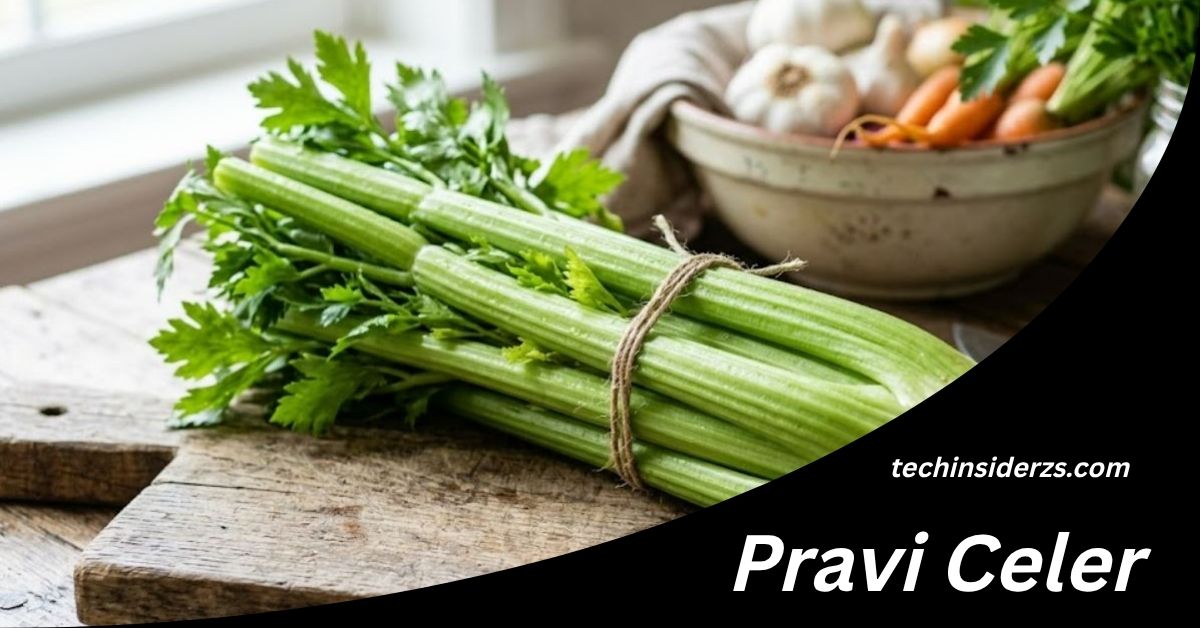
Pravi Celer: Everything You Need to Know About True Celery
Pravi celer is a term that can look unfamiliar to English-speaking readers, but the plant behind the name is much more familiar. In most contexts, pravi celer refers to celery, especially the cultivated celery plant known scientifically as Apium graveolens.
The phrase is associated with South Slavic languages and can be understood in English as “true celery” or “real celery.” In Croatian, “pravi celer” is also used as a common name connected with Apium graveolens. Botanical references recognize Apium graveolens as an accepted species in the Apiaceae family.
The topic can become confusing because some online sources describe pravi celer as a special variety, a traditional whole-plant food, or a type of celery that is somehow different from supermarket celery. Those descriptions should be viewed carefully. There is no strong botanical evidence that “pravi celer” is a separate species or a newly discovered superfood.
A better way to understand the term is to look at the plant itself, its regional name, the different forms of celery, and the ways people use different parts of the plant.
This guide explains what pravi celer means, where the name comes from, how celery relates to celeriac, what parts are edible, its nutritional value, cooking uses, possible health benefits, safety issues, growing conditions, storage, and common questions.
What Does Pravi Celer Mean?
Pravi celer can be translated approximately as “true celery,” “real celery,” or “genuine celery.”
The word “pravi” is used in South Slavic languages with meanings related to true, real, or genuine. “Celer” refers to celery.
The term therefore works mainly as a descriptive or regional name. It does not, by itself, establish a special botanical variety.
This distinction is important for people searching for pravi celer in English. A search may return pages suggesting that pravi celer is a rare vegetable or a recently discovered health food. That interpretation is not supported by the accepted botanical classification of the plant.
Kew Science lists Apium graveolens L. as an accepted species. Its natural range extends across parts of Europe, North Africa, and into western Asia, and the plant is described as a biennial species associated mainly with temperate conditions.
In simple terms, if you see “pravi celer” in a Balkan recipe, gardening discussion, or food article, the safest starting point is to think of it as celery and then check the context to determine which form or plant part is intended.
What Is Pravi Celer Botanically?
The scientific name associated with true or cultivated celery is Apium graveolens.
It belongs to the Apiaceae family. This is the same broad plant family that includes familiar herbs and vegetables such as parsley, carrots, fennel, and dill.
Kew Science recognizes Apium graveolens as an accepted species rather than treating it as a separate plant called pravi celer.
Celery is an interesting crop because humans have selected different forms of the same species for different purposes. Some forms are grown mainly for their stalks. Others are valued for their leaves, seeds, or enlarged base.
This means two celery plants can look quite different while still belonging to the same species.
For example, the celery commonly sold in American supermarkets is usually grown for its long, crisp leaf stalks. Celeriac, also called celery root, is grown mainly for its swollen underground base. Both are connected to Apium graveolens.
This is one reason that the phrase pravi celer can sometimes create confusion. A person may use it to describe celery generally, while another person may be thinking about a traditional plant that includes more of the edible parts.
Is Pravi Celer the Same as Regular Celery?
In most practical situations, yes.
Pravi celer is associated with the same celery species that English speakers normally call celery: Apium graveolens.
However, “same species” does not mean every celery plant looks or tastes exactly the same.
Cultivars and growing conditions can affect:
- Stalk size
- Leaf shape
- Flavor
- Color
- Texture
- Root development
- Seed production
- Growing time
Supermarket celery is usually selected for characteristics that work well in commercial production and fresh food sales. Traditional garden celery may look less uniform and may have stronger leaves or a more noticeable flavor.
That difference does not automatically make traditional celery healthier.
It is also important not to assume that “pravi celer” means organic, pesticide-free, wild, chemical-free, or medicinal. Those are separate claims that require separate evidence.
Pravi Celer and Celeriac: What Is the Difference?
Celeriac is one of the most common sources of confusion around celery terminology.
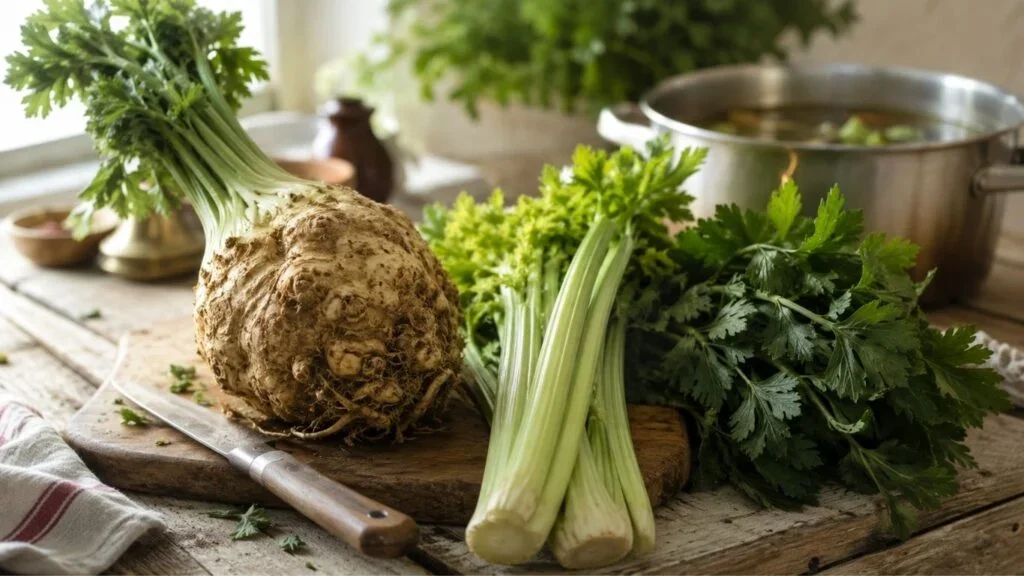
Celeriac is also called celery root. It is a cultivated form of Apium graveolens selected for its enlarged edible base.
Unlike familiar stalk celery, celeriac does not look like a large bunch of smooth green stalks. Its edible base is round, rough, and usually pale on the inside after peeling.
The flavor is related to celery but can be deeper and more earthy.
Celeriac is often used in:
- Soups
- Stews
- Mashed vegetable dishes
- Roasted vegetable recipes
- Purees
- Salads
- Vegetable stocks
- Grain and vegetable bowls
This means celeriac and stalk celery should not be treated as completely unrelated vegetables. They are different cultivated forms associated with the same species.
When an English-language source says that pravi celer means “celery root,” that may be a context-specific interpretation rather than a universal translation.
The most reliable approach is to look at the actual recipe or description. If the recipe talks about long green stalks, it means stalk celery. If it describes a rough, round root that must be peeled, it is probably referring to celeriac.
The Main Parts of Pravi Celer
One reason the phrase pravi celer can be interesting from a culinary perspective is that celery is more than its stalks.
Different forms of Apium graveolens can provide several useful plant parts.
Celery Stalks
The stalks are the part most Americans associate with celery.
They are crisp, watery, and mildly aromatic. They can be eaten raw or cooked.
Common uses include:
- Salads
- Snacks
- Soups
- Stews
- Stuffing
- Sauces
- Broths
- Stir-fries
- Vegetable mixes
Celery stalks also provide texture. Even when a recipe does not feature celery as the main ingredient, chopped celery can add crunch or a mild savory flavor.
Celery Leaves
Celery leaves are often overlooked.
They have a stronger flavor than the stalk and can be used much like a fresh herb.
You can chop celery leaves into:
- Soups
- Salads
- Sauces
- Broths
- Grain dishes
- Vegetable dishes
- Homemade stocks
Using the leaves can also reduce kitchen waste.
Celery Root or Celeriac
Celeriac is grown mainly for its enlarged base.
It is usually peeled before cooking because the outer surface is rough and uneven.
Once prepared, it can be:
- Roasted
- Boiled
- Mashed
- Pureed
- Added to soup
- Added to stew
- Shredded into salads
Its flavor is more intense than the flavor of many common root vegetables, with a clear celery-like character.
Celery Seeds
Celery also produces small aromatic seeds.
Celery seed is used as a seasoning in some foods. It can contribute a concentrated celery flavor to spice blends, pickling mixtures, sauces, dressings, and other dishes.
However, culinary celery seed should not automatically be treated as the same thing as a concentrated herbal supplement. Food and supplements can have different amounts, uses, and safety considerations.
Why Is Pravi Celer Sometimes Described as a “Whole Plant” Food?
Some modern discussions use pravi celer to describe a more traditional or complete way of using celery.
In that interpretation, the emphasis is not on a special botanical variety. Instead, the focus is on using more of the plant.
This can include stalks, leaves, seeds, and, depending on the cultivated form, the edible root or celeriac.
The idea is useful from a food-waste perspective. People often buy celery, use a few stalks, and throw away leaves or unused pieces. Using edible parts more fully can make a vegetable purchase more useful.
However, the whole-plant interpretation should not be confused with botanical classification.
There is no need to claim that a whole celery plant is a special species in order to appreciate the culinary value of its different parts.
A Short History of Celery
Celery has a long relationship with human food and traditional plant use.
Apium graveolens has a broad natural range that includes parts of Europe, North Africa, and western Asia. Kew describes the species as a biennial plant that occurs mainly in temperate environments.
Over time, people selected celery plants for different characteristics.
Modern agriculture did not simply “invent” celery. Instead, generations of cultivation and selection produced forms suited to different purposes.
Some forms became associated with large edible stalks. Others were selected for leaves, seeds, or enlarged roots.
This history helps explain why the word “celery” can refer to plants with noticeably different appearances.
It also explains why regional food traditions may use parts of the plant that are not as common in American supermarkets.
How Pravi Celer Is Used in Cooking
Celery is one of those vegetables that can be either the main ingredient or a background ingredient.
In the United States, it is often used with onions and carrots as part of a classic vegetable base for soups, stews, sauces, and other cooked dishes.
Its flavor can be especially useful when a recipe needs a fresh, aromatic vegetable note without adding a strong sweetness.
Raw celery is also popular.
It can be sliced into salads, served with dips, or eaten as a crunchy snack.
Celery leaves can provide a stronger flavor than the stalks, making them useful in dishes where a small amount of fresh celery flavor is desired.
Celeriac provides another option. It works particularly well in cool-weather dishes because it can add body and earthy flavor to soups, purees, and roasted vegetable recipes.
Is Pravi Celer Nutritious?
Celery can be a useful part of a balanced diet, but it is important to keep its nutritional value in perspective.
Celery is generally a low-calorie vegetable with high water content. It also provides dietary fiber and smaller amounts of several vitamins and minerals.
Its nutritional contribution depends on the amount eaten and the particular part of the plant.
Celeriac has a different nutritional profile from raw stalk celery because it is denser and contains more carbohydrate and energy per serving.
The important point is that celery can contribute useful nutrients, but it should not be treated as a miracle food.
A healthy diet is based on variety. Celery can be one part of that pattern alongside other vegetables, fruits, whole grains, beans, nuts, seeds, and appropriate protein sources.
Potential Health Benefits of Celery
Many health claims about celery appear online. Some are reasonable descriptions of its nutritional role, while others go much further than the evidence supports.
Hydration
Celery contains a large amount of water.
Eating water-rich vegetables can contribute to overall fluid intake, although celery should not replace drinking water when your body needs fluids.
Fiber
Celery contributes dietary fiber, especially when eaten as part of a diet containing many plant foods.
Fiber supports normal digestive function and can help make meals more filling.
However, eating celery alone is not a treatment for constipation or digestive disease.
Micronutrients
Celery contains vitamins and minerals, although the amount depends on the serving size and plant part.
A varied diet is the best way to obtain a broad range of nutrients.
Plant Compounds
Celery contains naturally occurring plant compounds that researchers have studied for antioxidant and other biological properties.
That research can be interesting, but laboratory findings do not automatically mean that eating celery prevents or treats a specific disease.
This is an important distinction when evaluating health content online.
Does Pravi Celer Have Special Medicinal Properties?
Claims about celery as a medicine should be treated carefully.
Apium graveolens has a history of traditional and medicinal use, and Kew records food and medicinal uses for the species.
However, traditional use is not the same as proof that a food or plant preparation can treat a medical condition.
This distinction is especially important with concentrated celery products, celery seed preparations, extracts, and supplements.
Eating celery as a vegetable is very different from taking a concentrated product.
If someone is considering celery supplements for a medical reason, it is sensible to discuss the product with a qualified health professional, especially if they take prescription medications or have a medical condition.
Is Celery Juice the Same as Eating Pravi Celer?
No.
Celery juice is made by extracting liquid from celery, while eating whole celery provides the complete food structure, including fiber.
Juicing can be a way to consume celery, but it should not be presented as automatically healthier than eating the vegetable.
Some internet claims describe celery juice as a special treatment for many diseases. Those claims should not be accepted simply because they are popular online.
There is no reason to treat celery juice as a cure-all.
For most people, whole vegetables can fit easily into a balanced diet without requiring a special wellness program.
Pravi Celer and Weight Loss Claims
Celery is often promoted online as a “negative calorie” food.
That phrase is misleading.
Celery is low in calories, and foods with high water content can be useful in a balanced eating pattern. But the idea that eating celery causes the body to burn more calories digesting it than the food contains is not a reliable basis for a weight-loss plan.
Weight management depends on many factors, including overall food intake, physical activity, sleep, health conditions, medications, and individual circumstances.
Celery can be part of a healthy diet, but it is not a magic weight-loss food.
Can You Eat Pravi Celer Raw?
Yes.
Stalk celery is commonly eaten raw.
Before eating fresh celery, rinse it under running water and remove dirt or damaged portions.
Raw celery can be:
- Sliced into salads
- Cut into sticks
- Served with dips
- Added to sandwiches
- Mixed into slaws
- Added to cold grain dishes
The leaves can also be used if they are fresh and clean.
Celeriac is usually prepared differently. Because of its rough exterior, it is commonly peeled before being eaten or cooked.
How to Store Fresh Celery
Fresh celery generally keeps better when it is protected from drying out.
At home, keep fresh celery refrigerated.
If the stalks become slightly soft, they may sometimes regain some crispness after being placed in cold water for a period of time. However, vegetables showing signs of spoilage, such as a bad smell, mold, or extensive decay, should be discarded.
For celeriac, choose firm roots without major soft spots or signs of spoilage.
Proper storage helps preserve quality and reduces unnecessary food waste.
Food Safety and Pravi Celer
Fresh vegetables are generally safe when handled properly, but produce can carry dirt or microorganisms.
The U.S. Centers for Disease Control and Prevention recommends washing fruits and vegetables under running water before preparing or eating them. Washing produce is an important basic food-safety practice.
Do not assume that a vegetable is automatically safe because it is organic, locally grown, traditionally grown, or marketed as “natural.”
Those labels describe production or marketing characteristics, not a guarantee that harmful microorganisms are absent.
Good kitchen habits include:
- Wash hands before preparing food.
- Wash fresh produce under running water.
- Use clean cutting boards and utensils.
- Keep raw foods separated from foods that are ready to eat.
- Refrigerate perishable foods promptly.
- Throw away produce that has clear signs of spoilage.
Can People Be Allergic to Celery?
Yes.
Celery allergy is real, although celery is not one of the nine major food allergens that U.S. federal law specifically recognizes for major-allergen labeling.
The FDA explains that the United States recognizes nine major food allergens: milk, eggs, fish, crustacean shellfish, tree nuts, peanuts, wheat, soybeans, and sesame.
The FDA also notes that other countries may identify additional foods, including celery, as priority allergens.
This difference matters when Americans buy imported foods or read information from European sources.
Someone with a known celery allergy should not assume that the absence of a U.S. major-allergen statement means celery cannot be present.
If a person has previously experienced an allergic reaction to celery, they should follow the advice of their healthcare professional and carefully check ingredient information.
Severe allergic reactions can be emergencies.
Pravi Celer and Medication Concerns
Eating ordinary amounts of celery as a vegetable is different from taking concentrated celery extracts or supplements.
Some people may use celery products because of claims about blood pressure, fluid balance, inflammation, or other health effects. However, concentrated preparations can behave differently from ordinary food.
Anyone taking prescription medication should be cautious about combining medicines with concentrated herbal products.
This is especially important for people taking medications that affect blood pressure, fluid balance, blood clotting, or kidney function.
The safest approach is simple: food is food, while concentrated supplements deserve a separate safety evaluation.
Can You Grow Pravi Celer at Home?
Yes.
If by pravi celer you mean Apium graveolens, it can be grown as a garden crop.
Celery generally prefers cool growing conditions, consistent moisture, fertile soil, and a steady supply of nutrients.
One reason celery can be challenging for beginners is that it does not respond well to being allowed to dry out repeatedly.
A basic home-growing plan includes:
- Choose a location with suitable sunlight.
- Prepare fertile soil with good moisture retention.
- Start seeds early enough for your local growing season.
- Transplant carefully if starting indoors.
- Keep the soil consistently moist.
- Provide appropriate nutrition.
- Watch for pests and plant diseases.
- Harvest according to the cultivar.
The exact planting date depends heavily on climate.
In the United States, gardeners in different regions have very different growing seasons. A planting schedule suitable for Minnesota may not work well in Florida, Arizona, or the Pacific Northwest.
What Soil Does Celery Need?
Celery generally performs best in fertile soil that can hold moisture while still allowing excess water to drain.
Dry soil can create problems because celery needs regular moisture.
Adding well-managed organic matter can improve soil structure and water-holding capacity.
However, constantly saturated soil can also create problems. The goal is consistent moisture rather than permanent waterlogging.
Gardeners should also consider soil testing before applying large amounts of fertilizer.
More fertilizer is not always better.
How Much Water Does Celery Need?
Celery is known for needing regular moisture.
This is one of its biggest differences from drought-tolerant vegetables.
If the soil repeatedly dries out, plant growth and stalk quality can suffer.
Mulching around plants can help conserve soil moisture and reduce rapid changes in soil temperature.
The exact watering schedule depends on:
- Temperature
- Rainfall
- Soil type
- Container versus garden growing
- Plant size
- Local humidity
- Sun exposure
Instead of following a rigid daily watering rule, gardeners should check the soil and local conditions.
Common Confusion About “Wild Celery”
The phrase wild celery can create additional confusion.
Wild forms and related plants can look similar to cultivated celery, but not every plant that resembles celery is safe to eat.
This is particularly important for people foraging in the wild.
The Apiaceae family contains many plants, and some are poisonous.
Therefore, someone should never identify a wild plant as edible simply because it resembles celery or because an online photograph looks similar.
Foraging requires reliable plant identification skills.
If there is any uncertainty, the plant should not be consumed.
Pravi Celer vs. Supermarket Celery
It is tempting to create a simple comparison in which traditional pravi celer is described as “better” than supermarket celery.
That would be an oversimplification.
Supermarket celery is often selected for uniform stalks, transportability, appearance, and storage performance.
A garden-grown plant may have different characteristics because of its cultivar, maturity, soil, weather, harvesting time, and handling.
Neither automatically wins every category.
A useful comparison is:
| Feature | Traditional or regional celery use | Typical supermarket celery |
| Main idea | Regional food terminology and broader culinary use | Commercial fresh vegetable |
| Scientific species | Apium graveolens | Apium graveolens |
| Common edible part | May include stalks, leaves, seeds, or root form | Usually stalks and leaves |
| Appearance | Can vary by cultivar | Usually uniform |
| Flavor | Can be stronger depending on variety and maturity | Often mild and crisp |
| Availability | Depends on region | Widely available in U.S. stores |
| Organic status | Not implied by the name | Not implied by the name |
| Health claims | Should be evidence-based | Should be evidence-based |
The most important takeaway is that “traditional” and “commercial” describe ways of growing, selling, or using food. They do not automatically describe nutritional quality.
Why Is Pravi Celer Becoming a Search Term?
The growing interest in terms such as pravi celer can be understood as part of a larger trend.
Internet users increasingly search for unfamiliar food names after seeing them in recipes, social media posts, gardening content, or international food discussions.
A person may encounter the phrase while looking for:
- Balkan recipes
- Croatian ingredients
- Bosnian cooking
- Serbian cooking
- Traditional vegetables
- Celery varieties
- Celeriac
- Herbal ingredients
- Garden plants
- Healthy vegetables
Search engines can then connect the phrase with many different interpretations.
This is why a clear explanation is more useful than simply repeating the phrase “true celery.”
The key question is always: what does the writer mean by pravi celer in that particular context?
How to Check Claims About Pravi Celer Online
Online food information can mix accurate botanical facts with exaggerated health claims.
A few simple checks can improve digital literacy.
First, look for the scientific name.
If an article says that pravi celer is a completely new species, ask whether a recognized botanical authority supports that claim.
Second, separate food facts from medical claims.
Saying that celery contains water and fiber is very different from saying that celery cures a disease.
Third, look for reliable sources.
Botanical information is better checked against established botanical databases. Nutrition information is better checked against government or academic sources. Food allergy information is best checked against organizations such as the FDA.
Finally, be cautious when an article uses phrases such as “miracle food,” “secret cure,” “detox,” or “scientists don’t want you to know.”
These phrases are common warning signs of low-quality health content.
Frequently Asked Questions About Pravi Celer
1. Is pravi celer an official English name for celery?
No. “Pravi celer” is a regional term associated with South Slavic languages. In English, the plant is generally called celery, while its accepted botanical name is Apium graveolens. Kew Science recognizes Apium graveolens as the accepted species.
2. Does pravi celer mean organic celery?
No. The term does not establish an organic certification or farming method.
Organic status depends on the applicable production standards and certification system. A celery plant can be traditionally grown, commercially grown, organic, or conventionally grown regardless of whether someone calls it pravi celer.
3. Does pravi celer mean celery grown from an old seed variety?
Not necessarily.
A traditional recipe or regional reference may involve an older local cultivar, but the words “pravi celer” alone do not prove that the seed variety is old, heirloom, or genetically distinct.
To make that claim, you would need information about the actual cultivar or seed line.
4. Is celeriac a different species from pravi celer?
No. Celeriac is associated with Apium graveolens, the same accepted species associated with celery. The important difference is that celeriac is cultivated for its enlarged edible base, while common stalk celery is cultivated mainly for its stalks.
5. Can pravi celer be grown in a container?
Celery can be grown in containers if the container is large enough and provides adequate soil, drainage, nutrients, and moisture.
Container-grown celery may require closer attention to watering because containers can dry out faster than garden soil.
Pravi Celer and Sustainable Kitchen Habits
One useful lesson from the broader interpretation of pravi celer is the idea of using food more completely.
Celery leaves do not always need to be thrown away.
Fresh leaves can flavor soup, stock, salad, sauces, and other dishes.
Celery ends and trimmings can sometimes be used for stock if they are clean and still fresh.
This approach does not require buying a special product.
It simply means paying more attention to what is already edible.
Reducing food waste can also save money over time.
The same principle applies to many vegetables. Carrot tops, herb stems, broccoli stalks, and other commonly discarded parts may have culinary uses depending on the food and its condition.
How to Choose Good Celery
When shopping for stalk celery in the United States, look for stalks that feel firm and reasonably crisp.
Avoid produce with:
- Extensive wilting
- Slimy areas
- Strong unpleasant odors
- Mold
- Significant discoloration
- Signs of advanced decay
Leaves should look reasonably fresh rather than heavily damaged.
For celeriac, choose a firm root with no major soft or rotten areas.
Because freshness affects texture, purchasing only as much as you can reasonably use can help reduce waste.
What Does Pravi Celer Taste Like?
Taste depends on the part of the plant and the cultivar.
Stalk celery is usually crisp, fresh, aromatic, and mildly savory. Some celery can taste slightly bitter or have a stronger herbal character.
Celery leaves are usually more intense than the stalks.
Celery seed has a concentrated flavor and is therefore used more like a seasoning.
Celeriac has a celery-like flavor but tends to taste earthier and more substantial.
Cooking can change the flavor considerably. Raw celery emphasizes crispness, while simmering can soften the texture and blend the flavor into soups and sauces.
Is Pravi Celer a Superfood?
There is no scientific need to label it a “superfood.”
Celery is a nutritious vegetable that can contribute water, fiber, and micronutrients to the diet.
That is already enough to make it useful.
The “superfood” label often encourages unrealistic expectations. A healthy eating pattern does not depend on one unusual ingredient.
In fact, the more useful lesson from pravi celer is the opposite: ordinary foods can have value when they are used thoughtfully.
A Practical Way to Think About Pravi Celer
For an American reader, the simplest explanation is:
Pravi celer is a South Slavic term associated with true or cultivated celery, usually referring to Apium graveolens. Depending on context, it may emphasize traditional celery, regional culinary use, or broader use of the plant.
That definition avoids two common mistakes.
The first mistake is claiming that pravi celer is an entirely new vegetable.
The second is claiming that every use of the phrase specifically means celeriac or celery root.
The context matters.
If you see the phrase in a Croatian recipe, gardening article, Balkan food discussion, or international ingredient list, look at the surrounding description before deciding exactly which form of celery is intended.
Conclusion: What Pravi Celer Really Means
Pravi celer is an interesting example of how language, food culture, botany, and internet search behavior can overlap.
The phrase is commonly understood as “true celery” or “real celery,” and it is associated with Apium graveolens. Botanical authorities recognize Apium graveolens as an accepted species in the Apiaceae family.
It is not necessary to treat pravi celer as a mysterious new vegetable or miracle food.
Instead, it is more useful to understand the term through its regional and culinary context.
Celery can be grown for stalks, leaves, seeds, or an enlarged base such as celeriac. These forms can look different but remain connected to the same species.